
Angus Visitor Security
Visitor Security is an enterprise module within MRI Angus used by building managers and front-desk security teams to manage daily visitor operations across commercial properties.
This redesign focused on consolidating existing workflows, modernizing legacy interactions, and introducing restricted visitor management, all within the constraints of an existing enterprise design system.
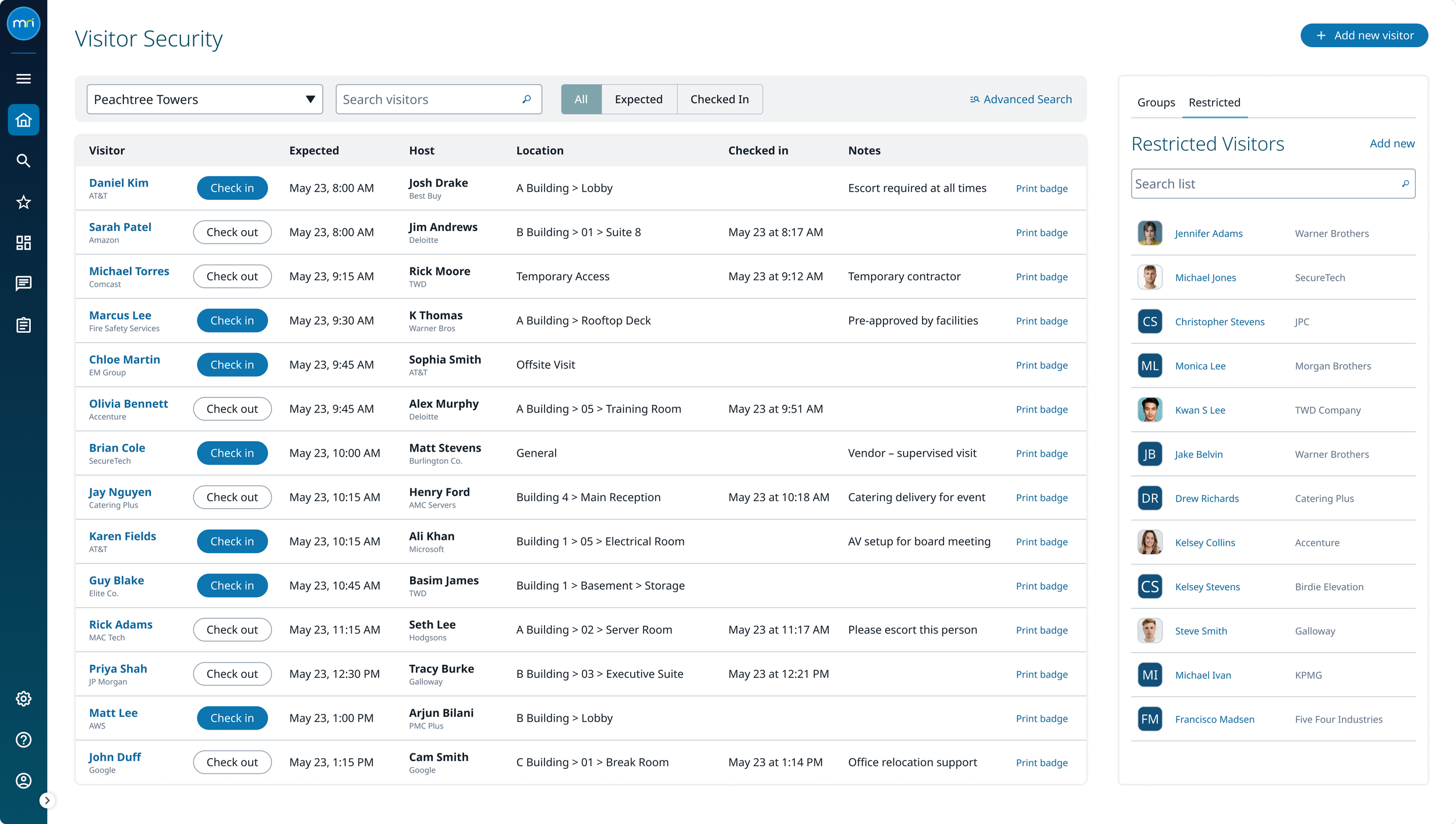
In my role as the lead product designer, I spoke with clients for friction and workflow validation, defined interaction architecture for the new designs, and collaborated with engineering on implementation and a phased rollout approach.
One process split across systems
Visitor management is a high-frequency, time-sensitive task. Security teams rely on speed and clarity, especially during peak hours when multiple visitors arrive at once.
In the legacy Visitor Security module, that workflow had evolved over time rather than being intentionally designed as a cohesive system. Key actions were distributed across different areas of Angus, with users relying on memory and training instead of usability.
Three separate lists for one workflow
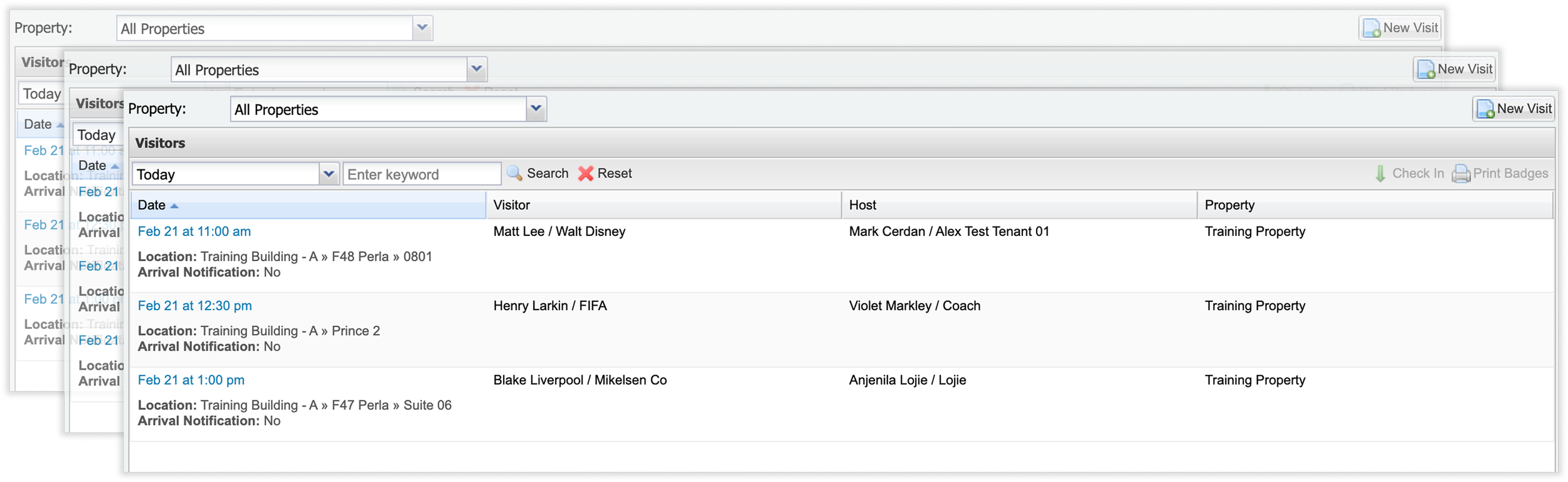
Visitor management required moving between three distinct destinations: Expected, Arrived, and Groups. Each list was accessed through different navigation paths instead of progressing through a continuous flow. Users had to remember where information lived and switch contexts to complete what was fundamentally one task.
Check-in wasn’t where decisons happened
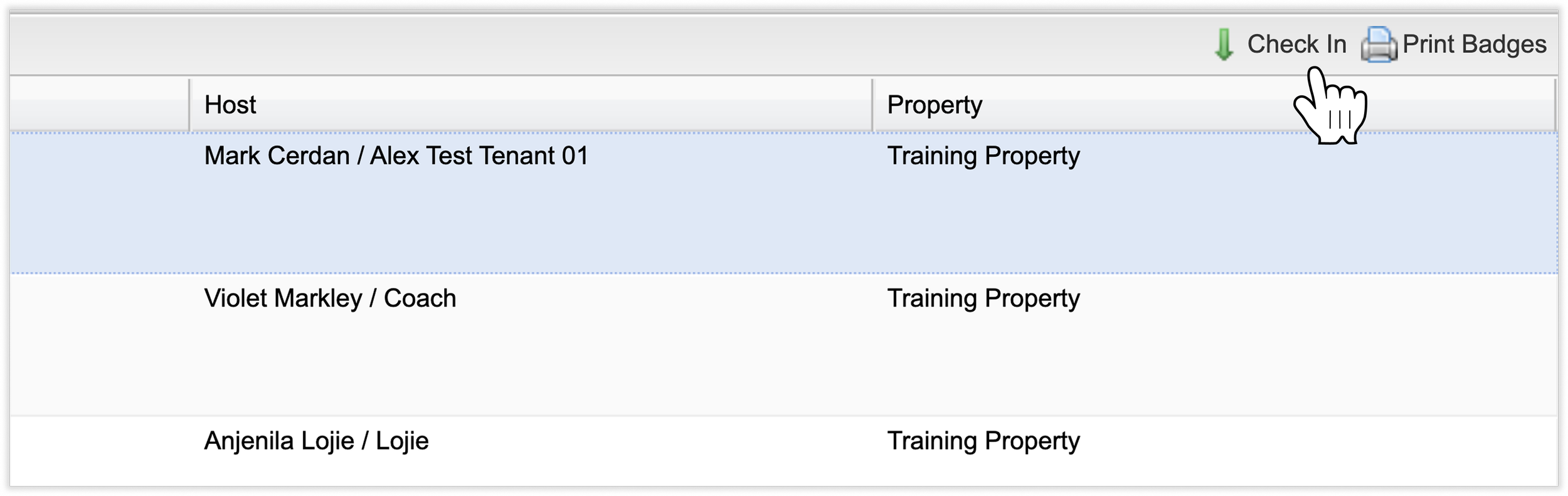
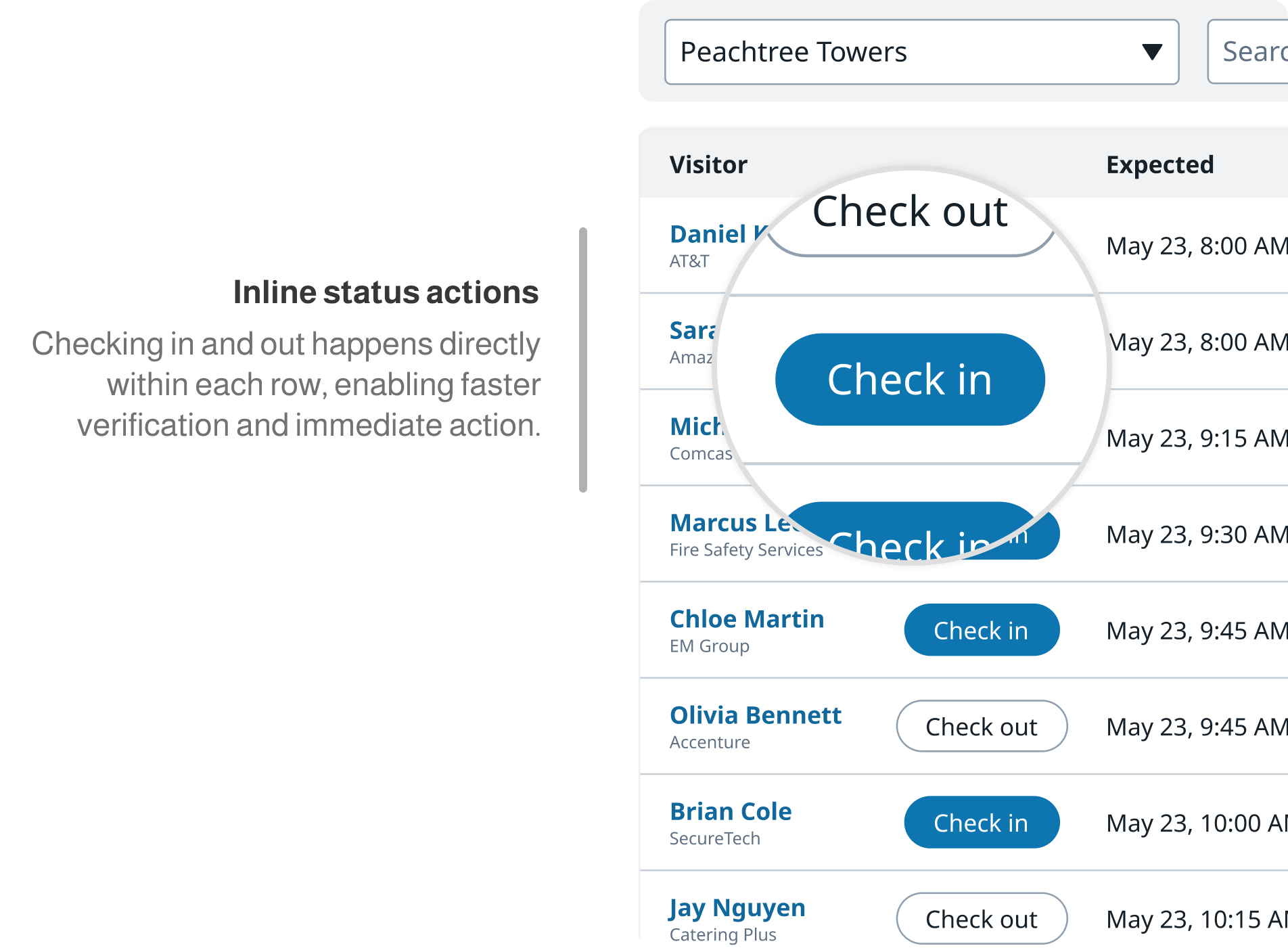
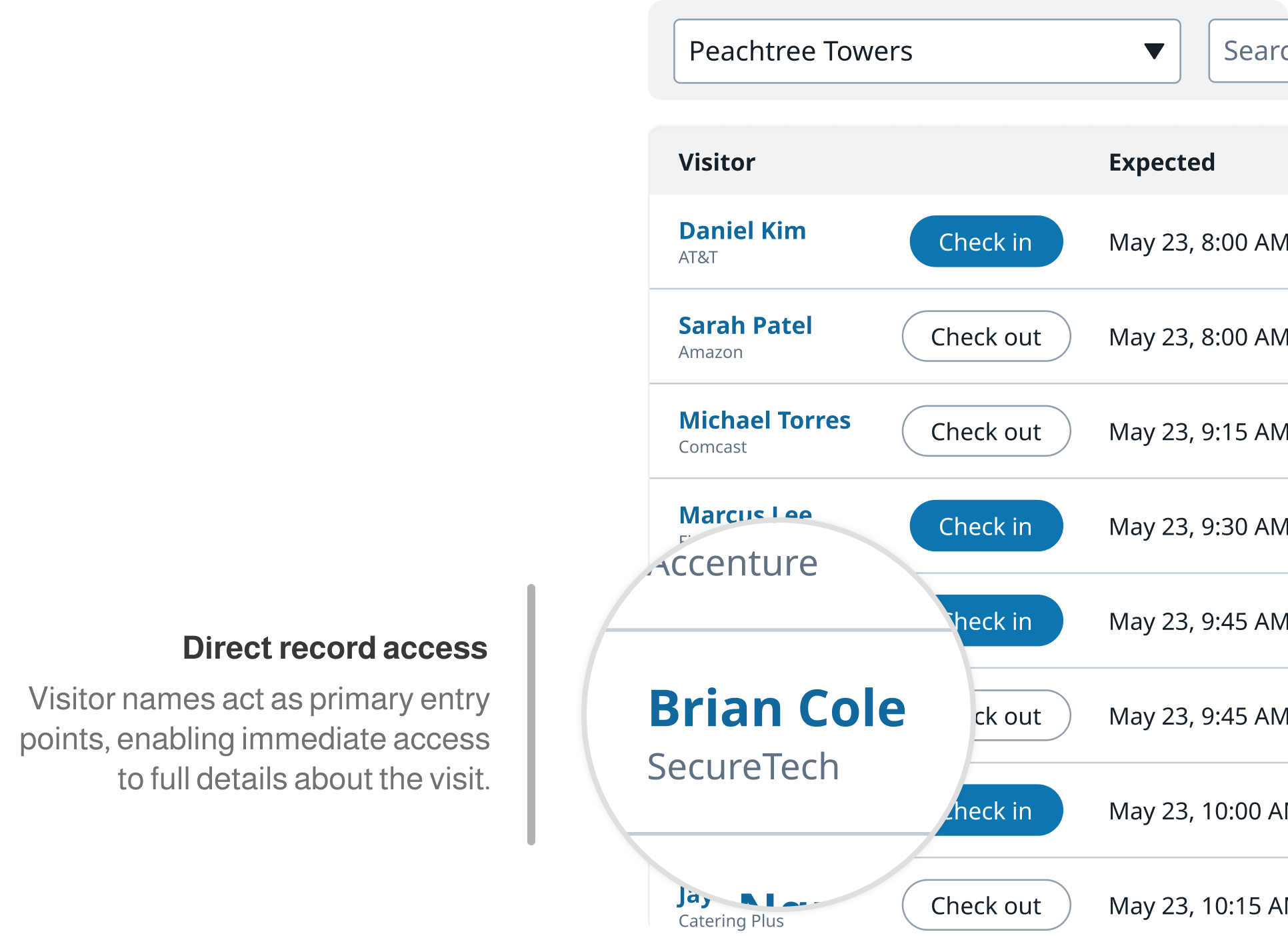
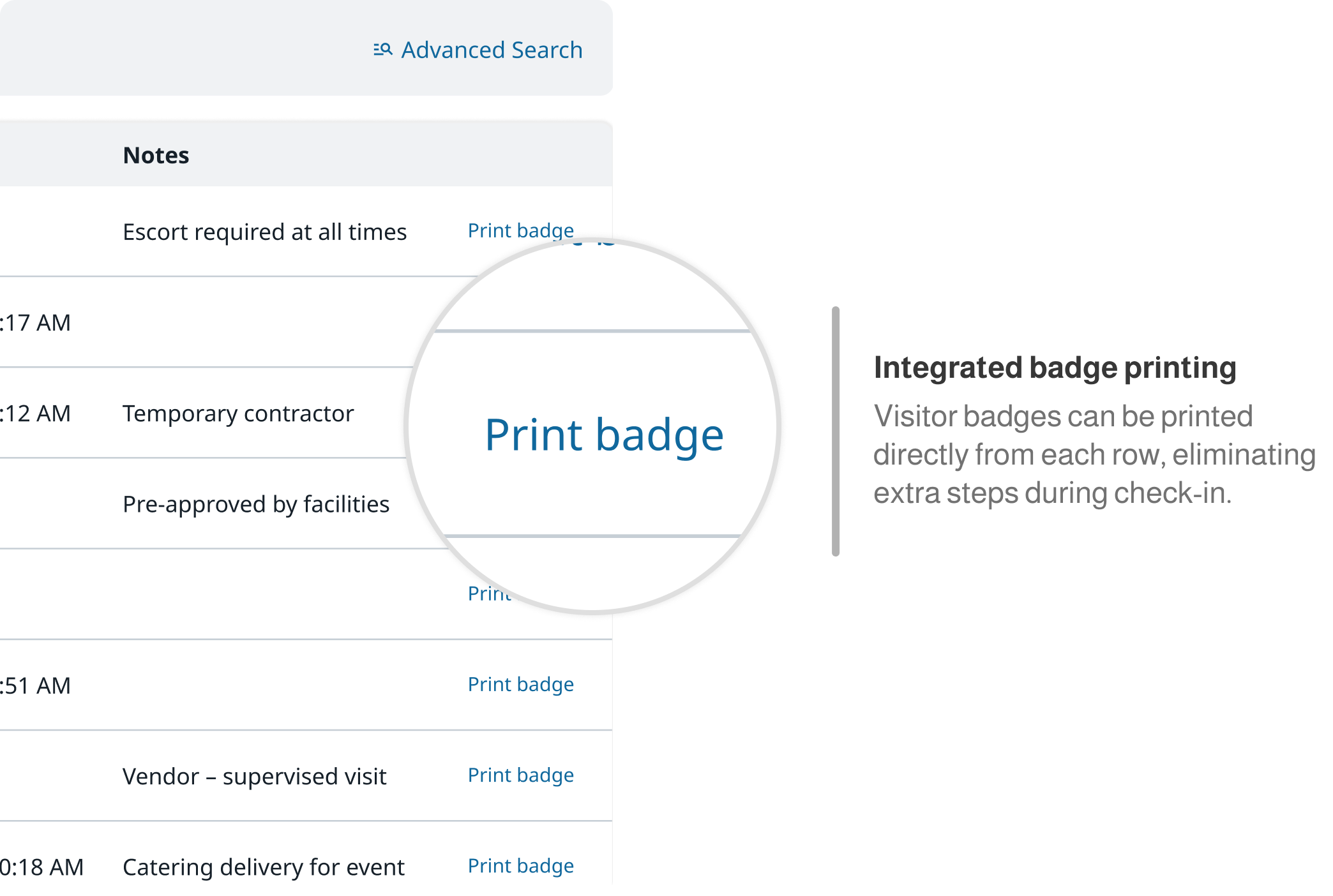
The primary action lived outside the row context. Users first had to select an entry, then trigger a global “Check in” button from the top bar. The interaction separated intent from execution, adding unnecessary friction to a task that should feel immediate and direct.
Search was powerful, but hard to access
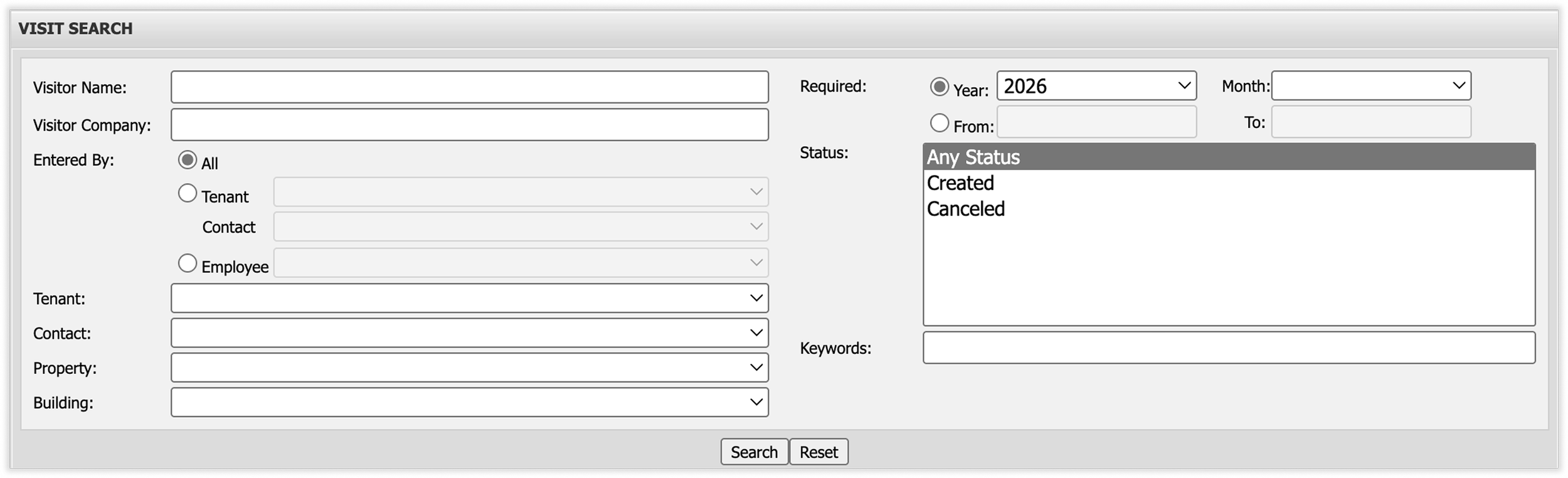
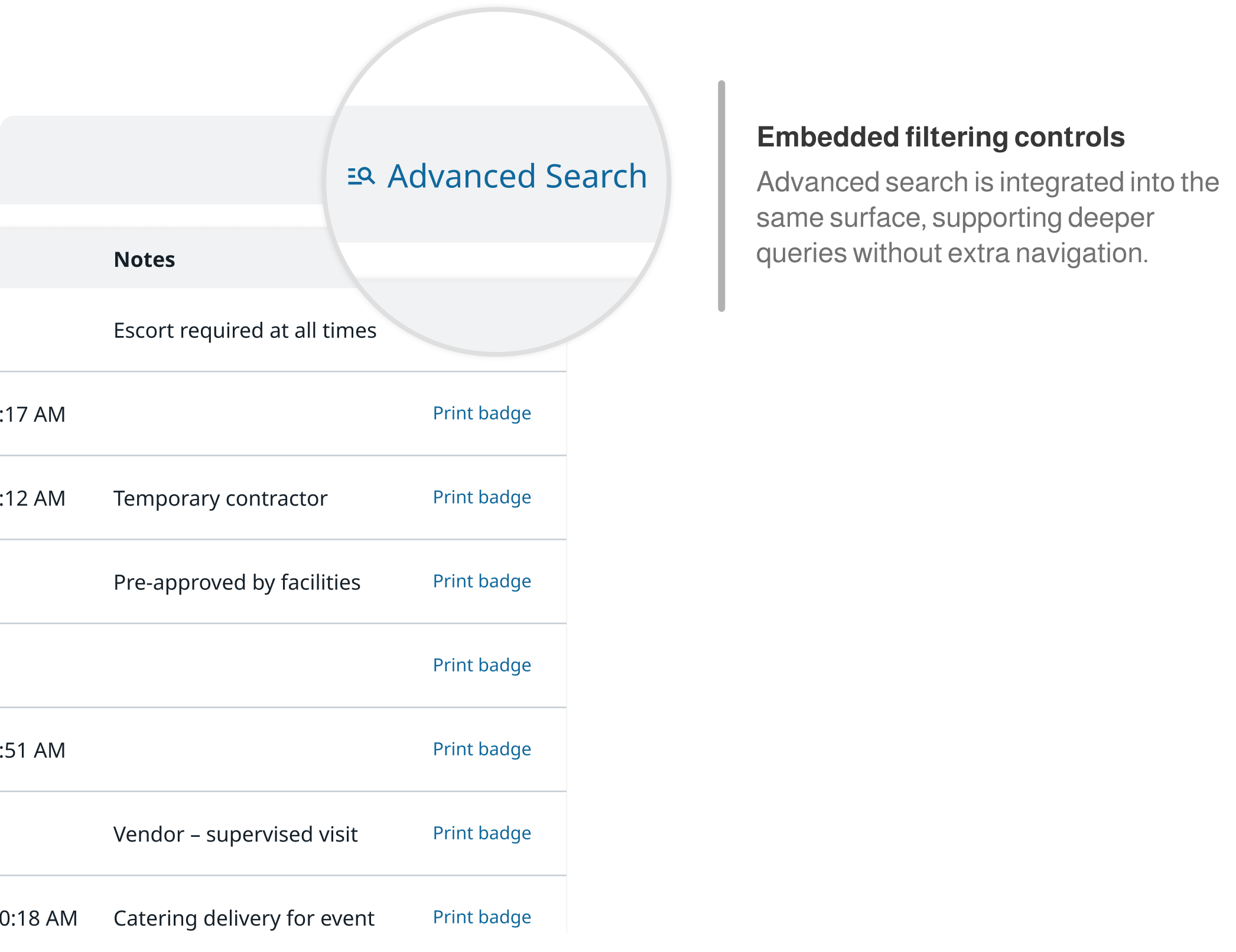
Advanced search to look for past records existed, but it was buried within global navigation and showed as a dense legacy form. While functionally capable, its placement and presentation discouraged quick and easy use.
Unifying the Visits experience
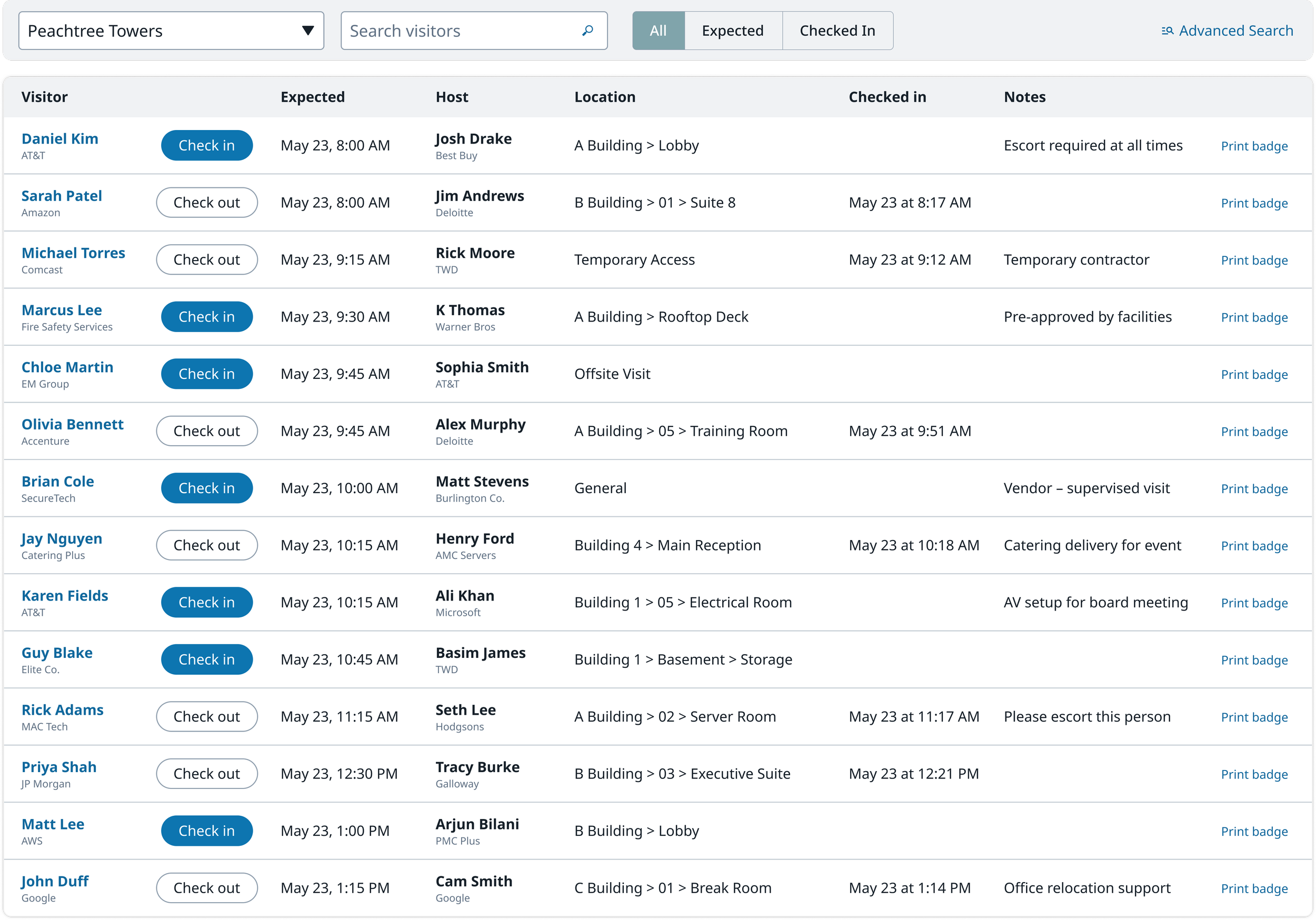
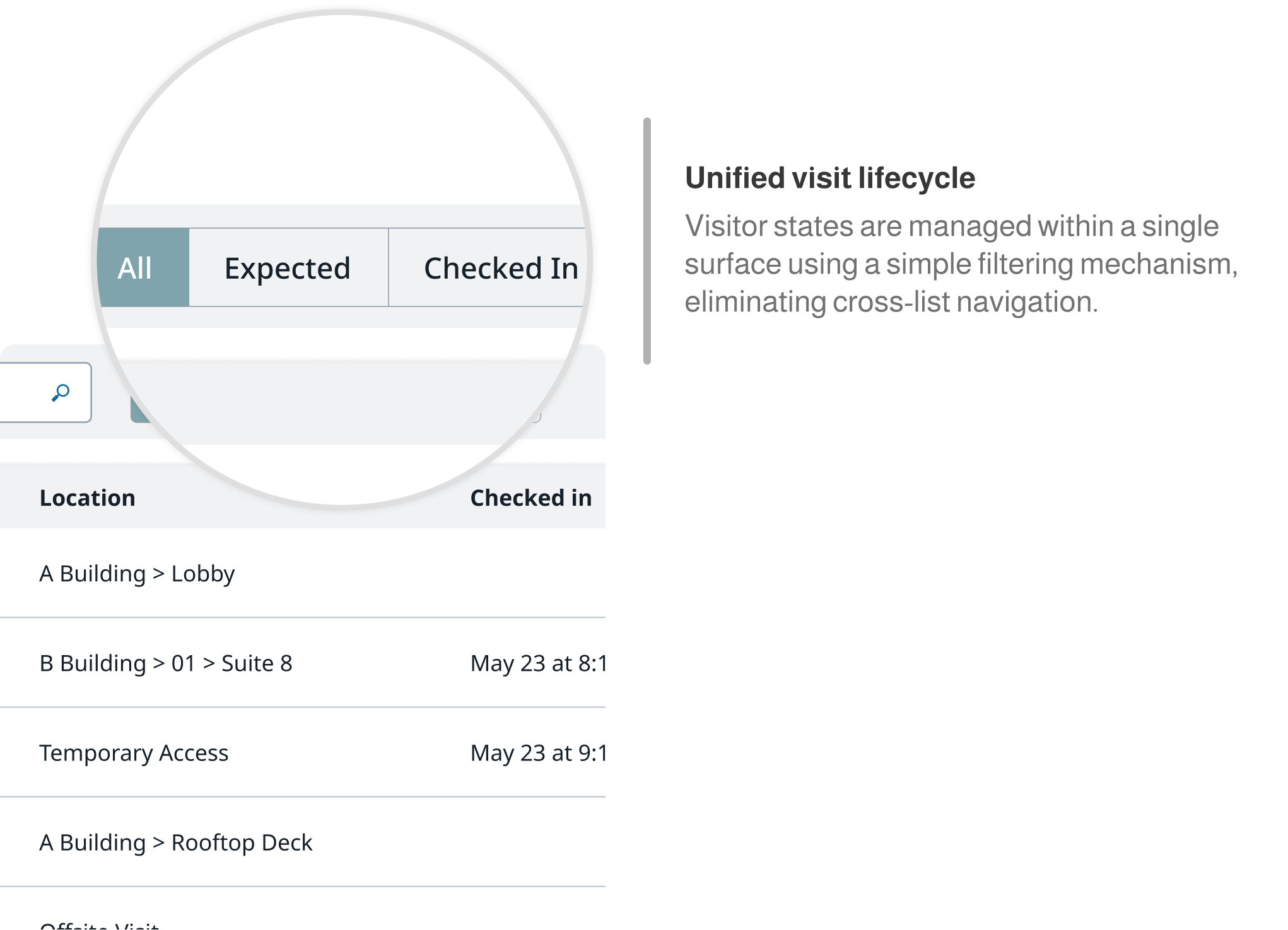
We realized that the issue was not visual; it was structural. We restructured the module around the task itself, where search, verification, action, and status coexist.
The goal was simple: eliminate unnecessary navigation and support the real-world reality of visitor management at the front desk.
Risk visibility in real time
Our new and improved Visitor Security module isn’t only about speed; it is also about accountability. Client feedback revealed a critical gap: viewing and managing restricted visitors was manual and disconnected from the check-in flow. Staff had to reference separate lists, increasing the risk of oversight during busy periods.
We shifted handling of restricted visitors, a key workflow, from reactive lookup to proactive detection.
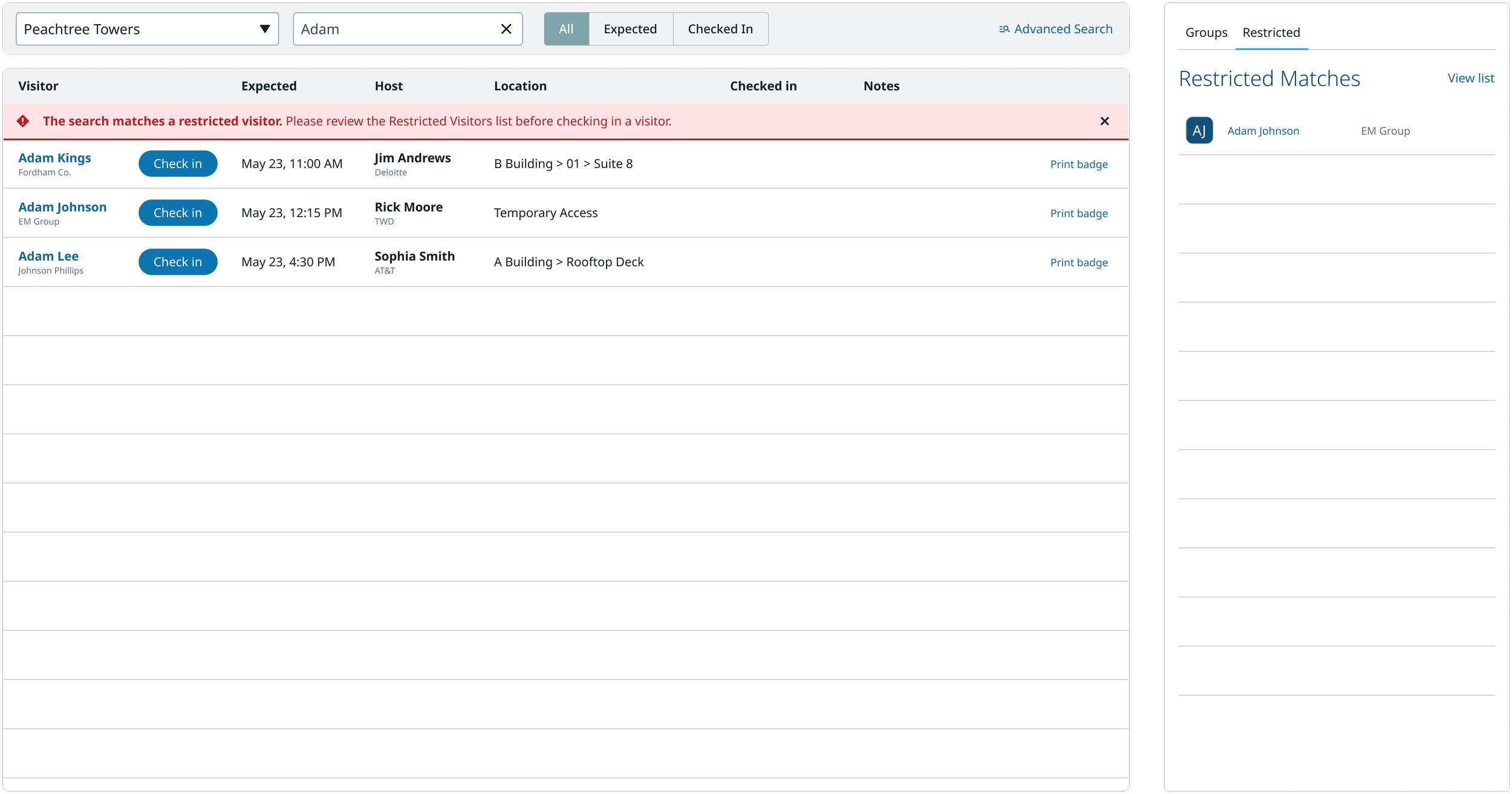
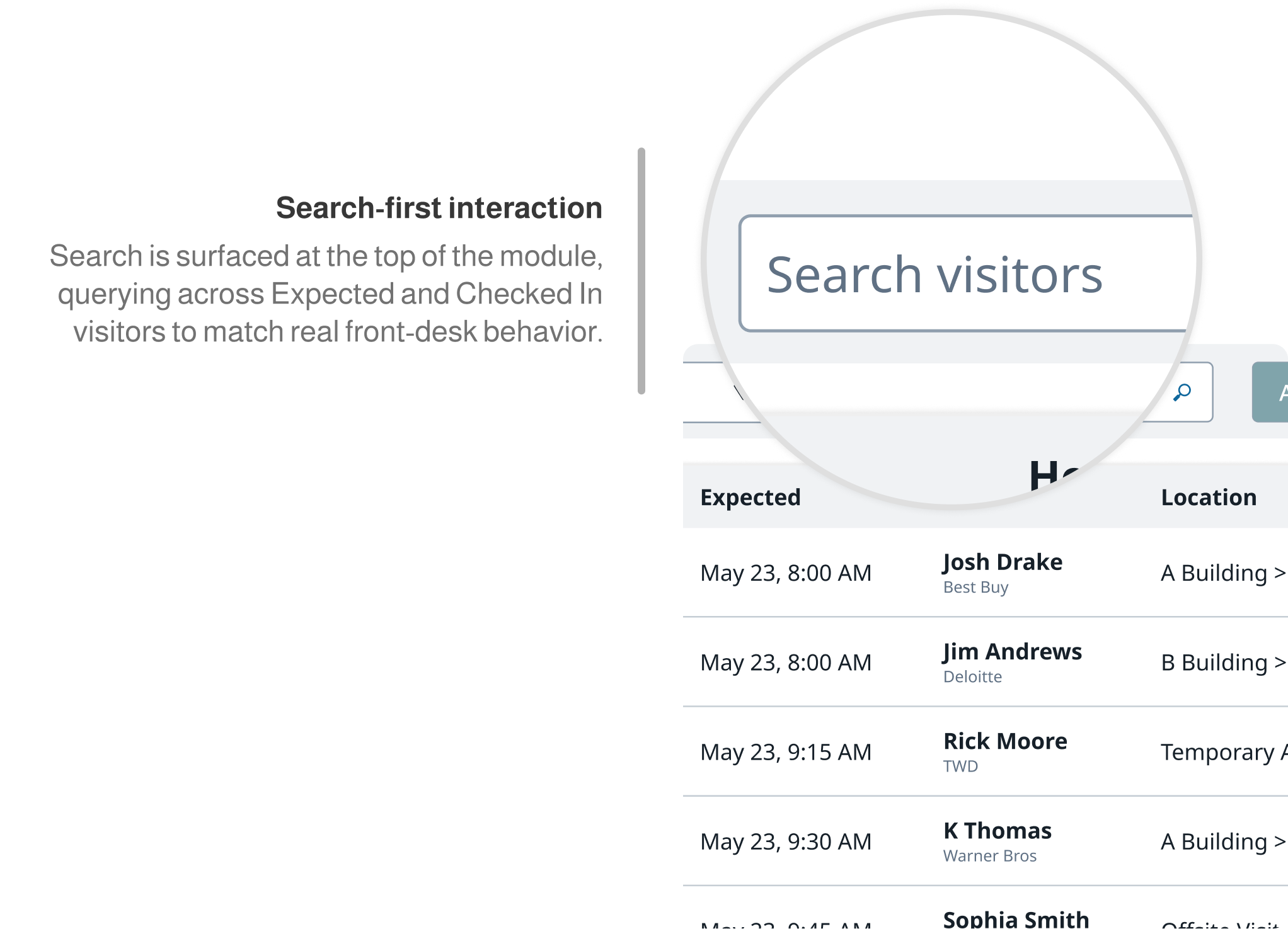
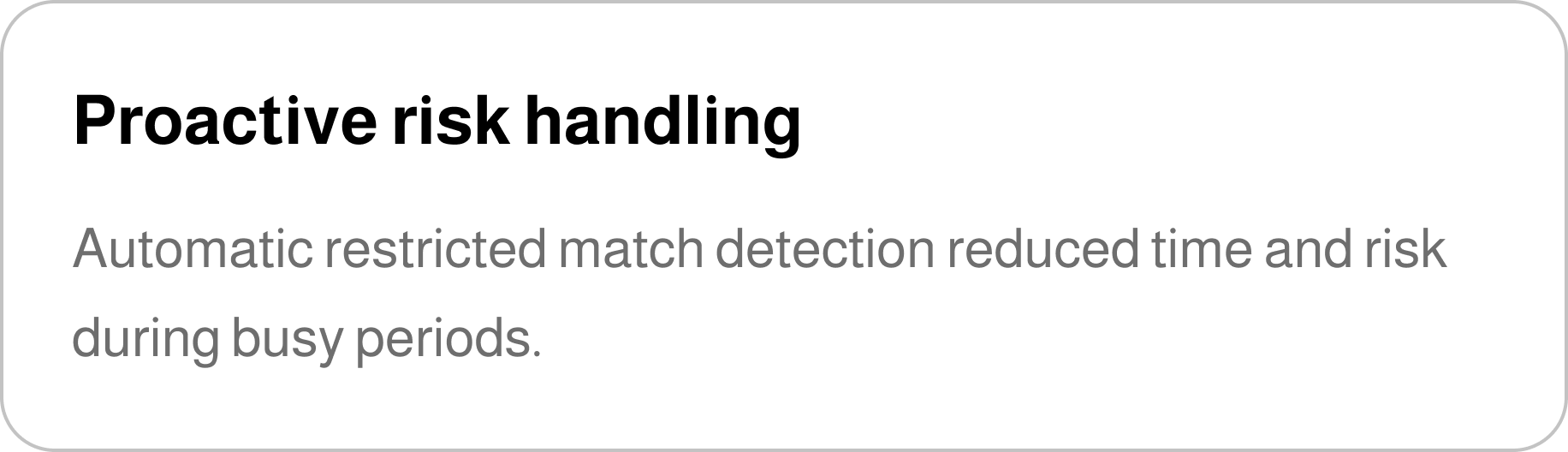
We introduced an automatic match detection, where every search triggers a real-time check against the restricted visitor list. Restricted matches are surfaced in the same interface, and security teams can maintain and review restricted records without leaving the module.
Designing for scale
Visitor volume varies dramatically across properties, from a handful of daily visits to hundreds during peak hours. The redesigned module supports both low- and high-volume environments without changing workflow patterns. Whether processing a single arrival or managing a large group, the interface remains predictable and efficient.
Efficient visitor management was not only about reducing clicks, but also about reducing cognitive load under pressure.
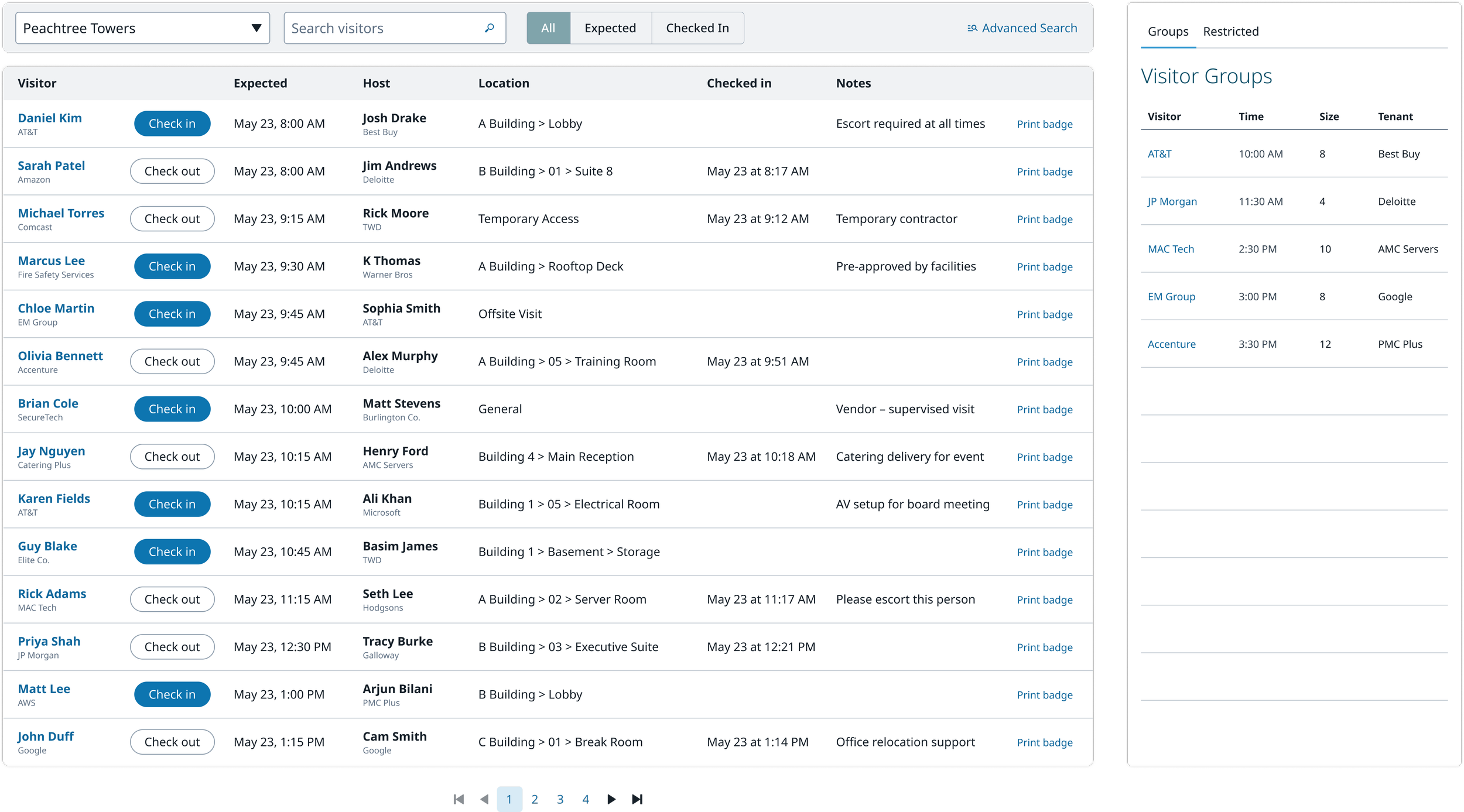
The Groups panel provides visibility into scheduled arrivals, giving security teams a high-level view of expected visitor groups for a given day. By surfacing group size, timing, and associated details within the same view, staff can anticipate traffic patterns, allocate resources appropriately, and pre-print badges for visits before they occur.
Operational impact
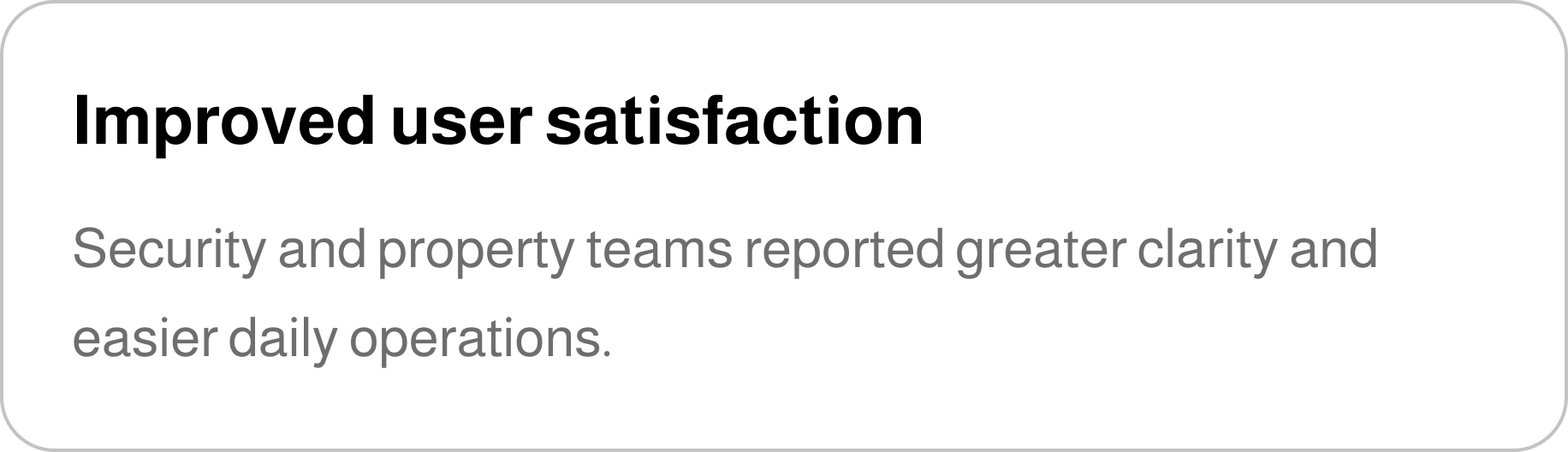
The redesigned Visitor Security module was introduced across pilot properties before broader rollout. The update was extremely well-received by security and property management teams, who cited improved clarity and ease of use. Improvements were measured against legacy workflows and prior visitor management patterns.
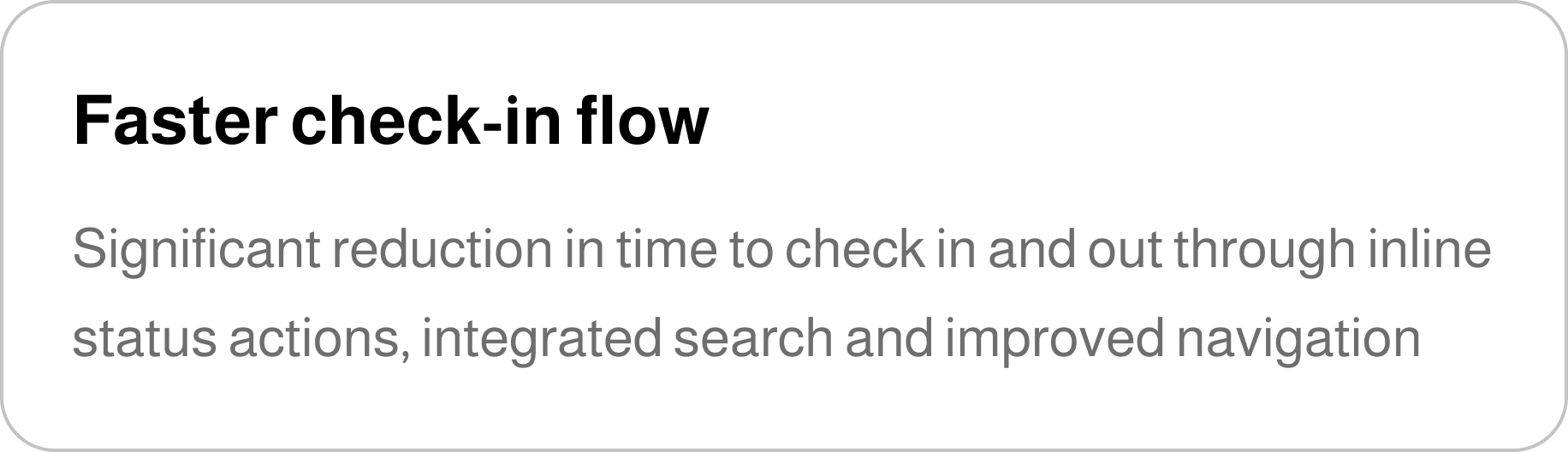

This project reinforced that operational design is hardly about adding features. It is about restructuring systems to match real-world behavior. Designing for a project with high-frequency tasks deepened my appreciation for systems thinking and the impact of reducing friction at scale.
As the platform evolves, there is opportunity to layer more intelligent automation into the experience, such predictive traffic insights, smarter flagging of risk, and adaptive workflows based on property size and visitor volume.